BLOG · PHARMA MARKETING GUIDE
The Complete Pharma Visual Aid Guide for Medical Representatives

A pharma visual aid is a printed or digital presentation booklet that medical representatives (MRs) use to explain a pharmaceutical brand's composition, benefits, and clinical evidence to doctors during a sales call — usually within a 2 to 3 minute window. It is the single most important promotional tool in Indian pharma marketing, and often the only physical thing standing between your brand and a doctor's prescription pad.
At RX Design Hub, we design and print pharma visual aids for 2,500+ clients across India, so this guide comes straight from the production floor — not from theory. Whether you are a first-time pharma entrepreneur launching your brand, a marketing manager planning a new campaign, or an MR who wants to use your visual aid better, this guide covers everything.
Why Is a Visual Aid So Important in Pharma Marketing?
Here is the reality of a doctor call in India: an MR gets 90 seconds to 3 minutes of a doctor's attention. In that time, the MR has to communicate the brand name, composition, mechanism, dosage, and why the doctor should prescribe it over five competing brands the doctor already knows.
Words alone cannot do this. A well-designed pharma visual aid does three things in that short window:
- Creates instant brand recall — a striking cover page and consistent brand colours make the doctor remember your product name even after the MR leaves.
- Simplifies complex science — mechanism-of-action diagrams, comparison charts, and clinical data graphs communicate in 10 seconds what would take 5 minutes to speak.
- Positions your company as professional — a cheaply printed, poorly designed visual aid silently tells the doctor your company cuts corners. A premium hardbound visual aid says the opposite.
This is why even small pharma franchises and PCD companies invest in professional visual aid design before anything else. It is the face of the company in the doctor's chamber.
Anatomy of a Pharma Visual Aid: What Goes Inside
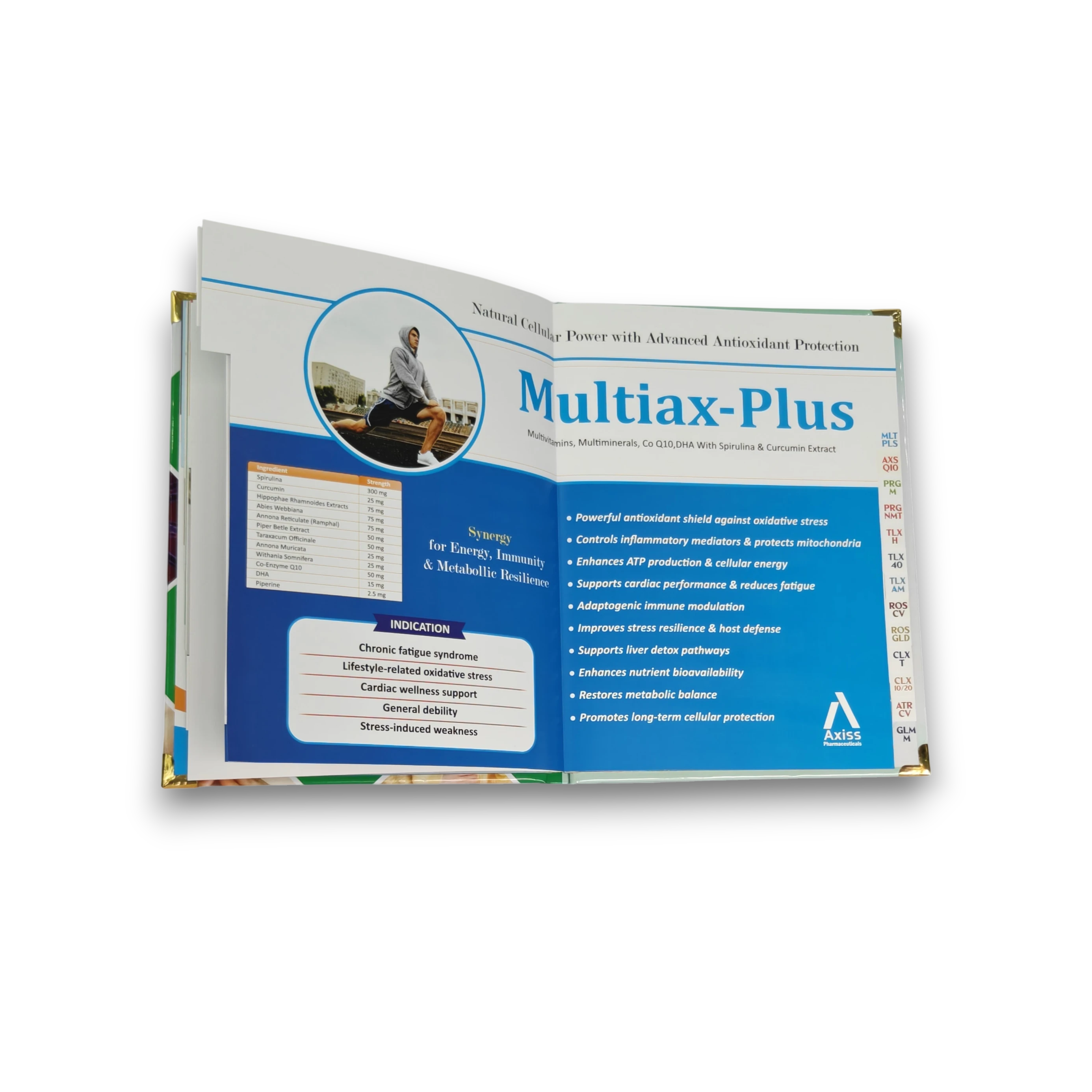
A standard pharma visual aid follows a proven structure. Here is what a complete visual aid contains, page by page:
| Section | Purpose |
|---|---|
| Cover page | Company logo, tagline, and a strong therapeutic visual. Sets the first impression. |
| Index / divider tabs | Coloured tabs separating therapy segments (e.g., Gastro, Ortho, Gynae) so the MR can jump directly to the relevant brand for that doctor. |
| Therapy opener pages | Introduces a disease segment with prevalence data or a patient-centric visual. |
| Brand pages | The core: brand name, composition, indications, dosage, USP, and supporting visuals. Usually 1–2 pages per brand. |
| Clinical evidence pages | Trial data, comparison tables, or references that build scientific credibility. |
| Back cover | Company details, product range summary, and contact information. |
The golden rule of a brand page: one page, one message. If a doctor glances at the page for 5 seconds, the single most important claim should be unmissable — in the headline, in the largest visual, and in the brand colour.
Types of Pharma Visual Aids
1. Printed Visual Aid (Hardbound / Wiro)
The classic format and still the most widely used in India. A printed visual aid is typically a hardbound or wiro/spiral-bound book that the MR carries to every call. Hardbound versions with laminated covers survive 6–12 months of daily field use, monsoon humidity, and being tossed into an MR's bag a hundred times.
2. E-Visual Aid (Digital Detailing Aid)
An e-visual aid is a tablet-based, interactive version used for digital detailing. It can include animations, videos, and clickable navigation. Larger companies use e-visual aids alongside print — not instead of it — because many doctors in Tier 2 and Tier 3 cities still respond better to a physical book they can hold and flip.
3. LBL (Leave Behind Literature)
An LBL is a single-sheet or folded leaflet the MR leaves with the doctor after the call. It repeats the key message of the visual aid so the brand stays on the doctor's desk. Many companies confuse LBLs with visual aids — the difference is simple:
| Visual Aid | LBL | |
|---|---|---|
| Who keeps it | The MR (reused in every call) | The doctor (left behind) |
| Format | Multi-page bound book | 1–4 page leaflet |
| Print quality | Premium, durable | Standard, high-volume |
| Purpose | Live presentation | Post-call recall |
4. Reminder Cards
Small cards focusing on a single brand, used for quick follow-up calls where a full detailing session is not possible. Reminder cards, LBLs, and visual aids together form the core print trio of pharma promotional inputs.
Standard Pharma Visual Aid Sizes and Print Specifications in India
This is the section most guides skip, because most guides are written by designers who never touch a printing press. As a company that handles both visual aid designing and printing services, here are the specs that actually get ordered in the Indian market:
Common sizes:
- 17" × 11" inch — standard visual aid size for a premium doctor-table presentation and multi-brand detailing.
- 15" × 10" inch — compact visual aid size for easier MR handling while still giving enough space for brand pages.
- 9" × 6" inch — small visual aid size for focused reminder-style detailing and quick product presentations.
Paper and finishing:
- Inner pages: 250–300 GSM art card for durability; 170 GSM art paper for high-page-count books
- Cover page: hardboard cover with printed paper wrapping and matte or gloss lamination for a premium, durable finish
- Lamination: Matte lamination gives a premium feel and reduces glare under clinic lighting; gloss makes colours pop
- Binding: Wiro (spiral) binding is standard because pages lie flat during presentation; hardbound with concealed wiro is the premium option
- Special finishes: Spot UV on the logo, gold/silver foiling on the cover, and embossed brand names for premium therapy segments (cardio-diabeto, derma, gynae)
Pro tip from our binding team: always ask for rounded corners on visual aid pages. Sharp corners fray within weeks of field use; rounded corners keep the book looking new for months.
How Much Does a Pharma Visual Aid Cost in India?
Cost depends mainly on page count, finish and quantity. Here is how it is usually built up:
- Design charges: usually per page and paid once per design; reprints of an approved design should not carry a design charge again
- Printing & binding: a rate per book set by page count and finish. Some printers add setup charges on small runs; at RX Design Hub the per-book rate is the same from 5 books upward, and the all-in cost per book falls as quantity rises because the design charge is shared
- Premium finishes (velvet, NTR non-tearable, matte + spot UV) add to the per-book rate but significantly increase perceived brand value in the doctor's chamber; matte and gloss cost the same
Most small and mid-size pharma companies order visual aids for 10–50 MRs at a time. For exact, current rates for your specific requirement, see how visual aid price is worked out, or pick pages, finish and quantity on the order page to see your exact total in a minute.
How MRs Should Use a Visual Aid in a Doctor Call
A visual aid is only as good as the MR presenting it. Here is the field-tested flow that top-performing MRs follow:
- Open to the right tab before entering. Never fumble through pages in front of the doctor. Index tabs exist for this reason.
- Hold it facing the doctor, not yourself. The visual aid is for the doctor's eyes. Present it like a menu, not like your personal notes.
- Point while you speak. Guide the doctor's eye to the exact chart or claim you are talking about. This doubles retention.
- One brand, one page, one message. Do not flip through five brands in one call. Detail the priority brand properly.
- Close with the LBL. Leave the single-sheet literature so the message survives after you exit.
Pharma companies should train MRs on the visual aid during cycle meetings — walk through every page, explain the story behind each visual, and role-play the 2-minute call.
What Makes a Good Pharma Visual Aid Design? (7-Point Checklist)
After designing visual aids across virtually every therapy segment — from antibiotics and PPIs to derma, ortho, gynae, and nutraceuticals — these are the seven non-negotiables we apply to every project:
- Doctor-first hierarchy — the key claim readable from 3 feet away
- Scientific accuracy — every claim backed by the composition and referenced data; doctors instantly lose trust in exaggerated claims
- Consistent brand identity — brand colours, fonts, and logo placement identical across visual aid, LBL, and reminder card
- Clean data visualisation — graphs and comparison tables instead of paragraph text
- Therapy-appropriate imagery — a paediatric brand and a cardiac brand should never look like siblings
- Print-ready technical setup — CMYK colour, 300 DPI images, proper bleed and margins so what you approve on screen is what comes off the press
- Durability engineering — paper GSM, lamination, and binding chosen for 6+ months of field life
If your current visual aid fails three or more of these points, it is costing you prescriptions. You can compare against our pharma visual aid samples to see what current-standard work looks like, or use our visual aid design mistakes checklist to audit your current book before the next cycle meeting.
How the Visual Aid Design Process Works (You Provide 2 Things, We Handle Everything)
One of the biggest myths that stops small pharma companies from getting professional visual aids: "We will have to write all the content, arrange the medical data, and supervise the designer."
No. A professional pharma visual aid design and printing company needs exactly two inputs from you:
- Your brand names
- Your compositions
From there, the complete pipeline — medical content writing, USP development, creative design, revisions, print-ready file preparation, printing, binding, and dispatch — is handled end to end. A typical visual aid project moves from brief to dispatched books in a structured design → approval → print → bind → dispatch workflow, with you approving designs on WhatsApp at each stage.
If you are evaluating vendors, read our guide on how to choose a visual aid design company — it covers the questions to ask before paying any advance.
Frequently Asked Questions
What is a visual aid in pharma?
A pharma visual aid is a printed or digital booklet that medical representatives use to present a pharmaceutical brand's composition, benefits, and clinical data to doctors during sales calls. It is the primary detailing tool in pharmaceutical marketing.
What is the difference between a visual aid and an LBL?
The visual aid stays with the MR and is reused in every doctor call, while the LBL (Leave Behind Literature) is a single-sheet leaflet left with the doctor after the call for brand recall.
What is the standard size of a pharma visual aid in India?
The common Indian pharma visual aid sizes are 17 x 11 inch standard, 15 x 10 inch compact, and 9 x 6 inch small. The right size depends on the number of brands, the MR's handling comfort, and how the book presents on a doctor's table.
How many pages should a pharma visual aid have?
Typically 8 to 24 pages depending on the number of brands, following the rule of 1-2 pages per brand plus cover, index, and therapy divider pages.
How long does it take to design and print a pharma visual aid?
Design typically takes a few working days per batch of brands depending on revisions, with printing and binding adding several more days. Companies should plan visual aids 3-4 weeks before their MR cycle meeting.
Do new pharma companies need a visual aid?
Yes — arguably more than established companies. For a new pharma company or PCD franchise, the visual aid is the first and often only proof of professionalism a doctor sees.
Free Download: The Pharma Visual Aid Planning Checklist
Planning a new visual aid for your company? Download our free 21-point Visual Aid Planning Checklist — the exact checklist our design team uses before starting any project. It covers brand info collection, content approval stages, print specs, and dispatch timelines, so nothing gets missed.
Related reading
- How Doctors Actually Read a Visual Aid: The 8-Second Rule
- 7 Visual Aid Design Mistakes That Kill MR Detailing
- What Is a Visual Aid in Pharma Marketing?
- How to Design a Pharma Visual Aid: Step by Step
- Visual Aid Design Samples
- Best pharma visual aid companies in India (2026 comparison)
- Pharma visual aid printing and design
- Visual aid vs leave-behind literature (LBL)
- E-detailing software for pharma: CLM vs e-visual aid app