Pricing Guide · Updated October 2026
Visual Aid Printing Price in India: How It Is Worked Out
Visual aid printing price at RX Design Hub is worked out from a fixed rate card, not a guess. Your total is the printing & binding rate per book (set by page count and finish) × quantity, plus a one-time design charge per page, plus 18% GST. Every book is back-to-back hardbound, paper is chosen automatically from the page count, and the minimum order is just 5 books.
The same rate card powers our online order page, so the price you see there is the price you pay. Pick pages, finish and quantity there and the full quotation with GST is on screen in a minute; place the order with your company name and WhatsApp number and pay 50% advance by UPI, or pay in full and save 1%.
What decides the rate per book
| Factor | Your options | How it affects price |
|---|---|---|
| Page count | Any count from 4 to 40 pages | The biggest lever. Each extra page adds paper, printing, pasting and binding work to every book. |
| Finish | Gloss, matte, velvet, NTR, matte + spot UV | Second biggest lever. Gloss and matte cost the same; velvet, NTR and matte + spot UV step up in that order. |
| Size | 17×11, 15×10 or 9×6 in | Does not change the rate. Pick the size that suits the MR bag and the doctor's table. |
| Quantity | From 5 books | The rate per book stays the same at any quantity, so there are no slab surprises. |
| Design | Design by us, or your print-ready file | Charged once per page for the whole order, so it spreads thinner as quantity rises. No design charge on a print-ready file or a reprint. |
How the total is calculated
Total = (rate per book × quantity) + (pages × design charge, once) + 18% GST. If you already have a print-ready file, the design line is zero. Because the design charge is paid once, the all-in cost per book falls as the quantity rises, even though the printing rate stays fixed.
The quickest way to see your number is the calculator: pick pages, finish and quantity on the order page and every line, including GST, is on screen in a minute. No sign-up and no payment needed to see the price.
Courier is charged at actuals on dispatch. Payment: 50% advance by UPI to start, balance before dispatch, or pay the full amount upfront and get 1% off.
What every visual aid includes
| Item | What you get |
|---|---|
| Design & content | Layout from your brand name and composition, print-ready artwork, 3 correction rounds, PDF proof on WhatsApp before printing. Charged once per page. |
| Binding | Back-to-back pasted hardbound: rigid, flat-opening pages that stand up during detailing. |
| Paper | Set automatically by page count: up to 24 pages on 300 GSM art paper, 25–30 pages on 250 GSM, 31–40 pages on 170 GSM, so thick books stay light enough for an MR bag. |
| Sizes | 17×11 in (close to A4), 15×10 in, or 9×6 in (close to A5), all at the same rate. |
| Minimum order | 5 books. |
| Timeline | Design proof in 3–6 working days; printing and binding 8–12 working days after you approve the proof; pan-India dispatch from Lucknow. |
Finish: what each one costs and why
Finish is the main lever on the per-book rate. Costliest to most economical: Matte + spot UV > NTR > Velvet > Matte = Gloss. Matte and gloss lamination cost the same, so choose between them on look and feel alone.
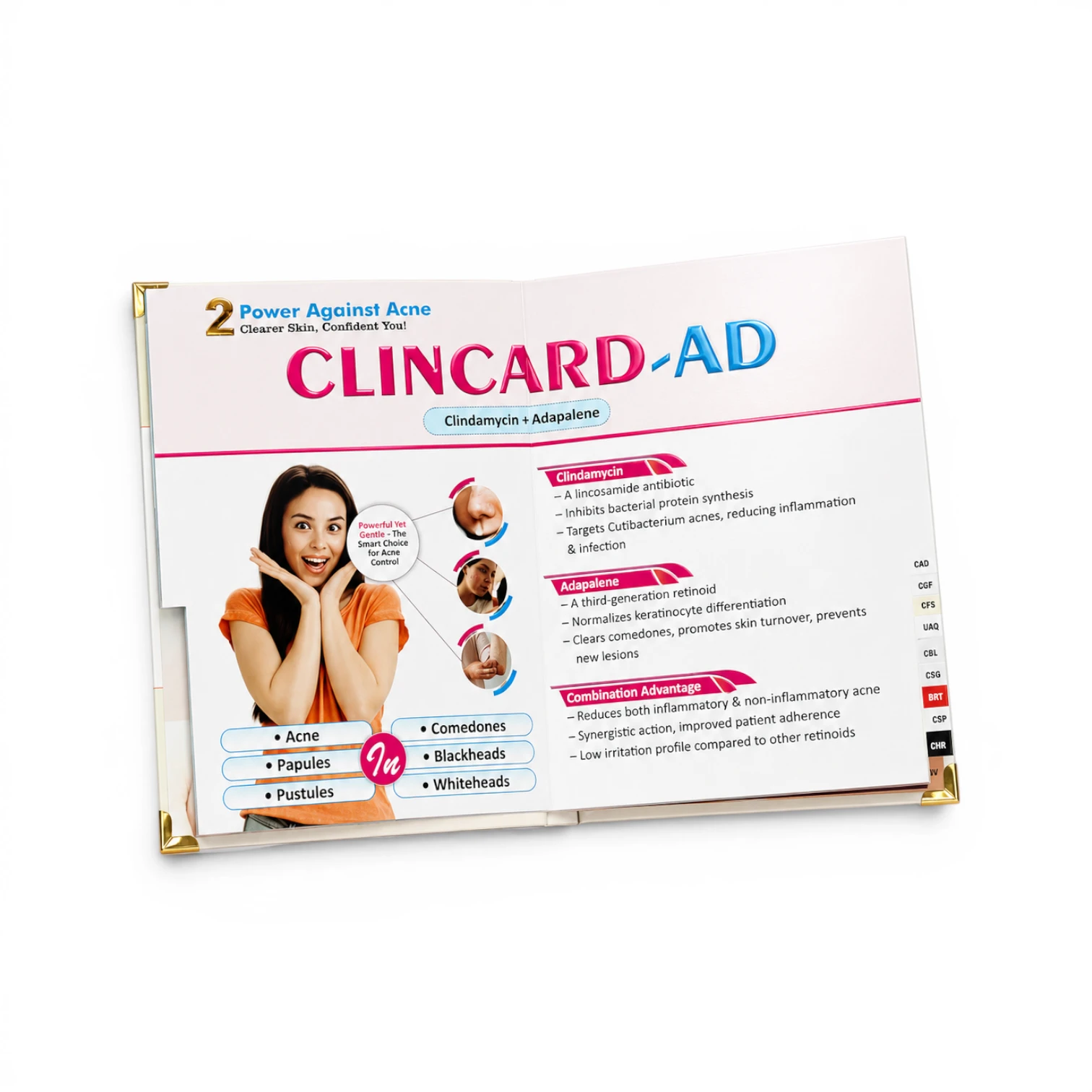
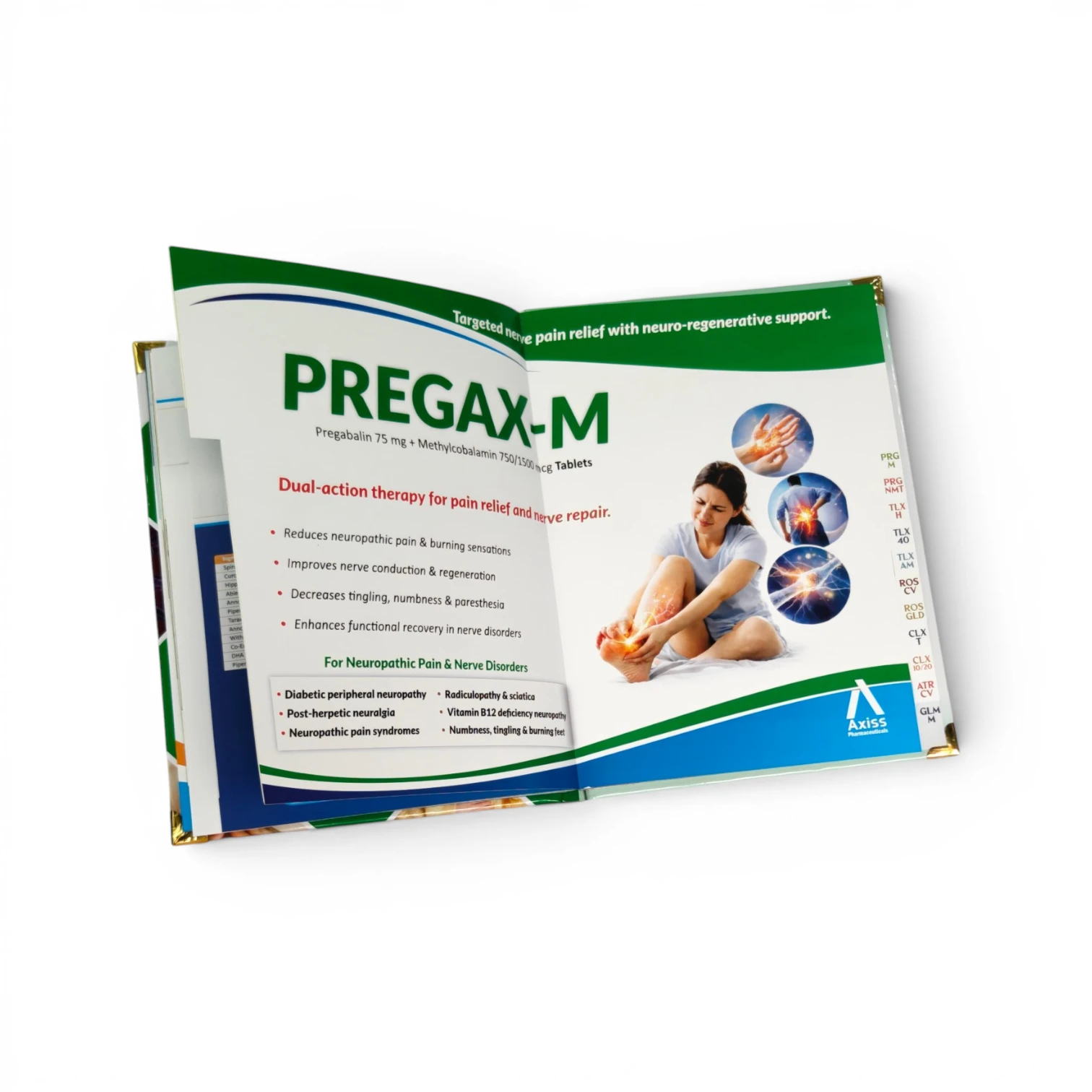
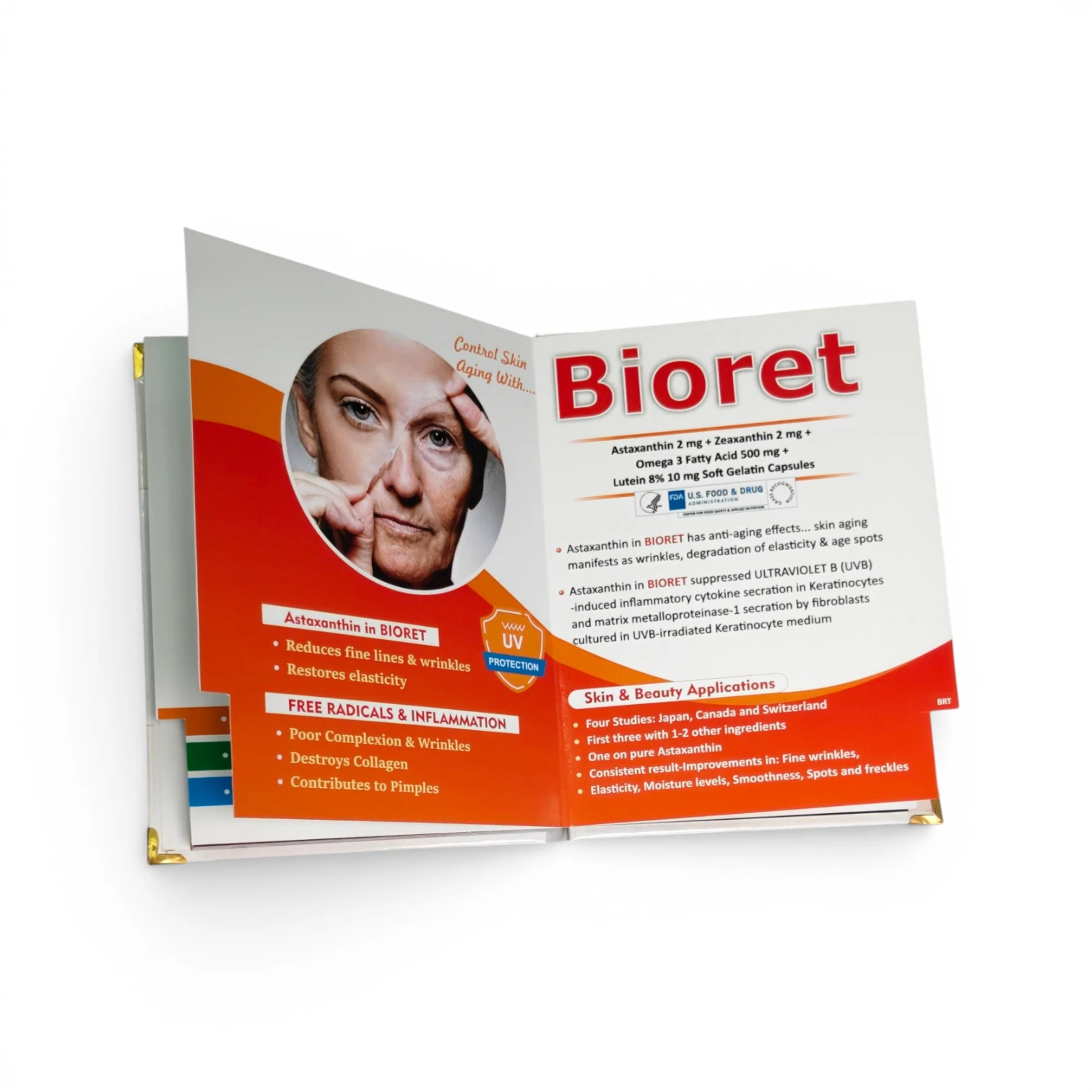
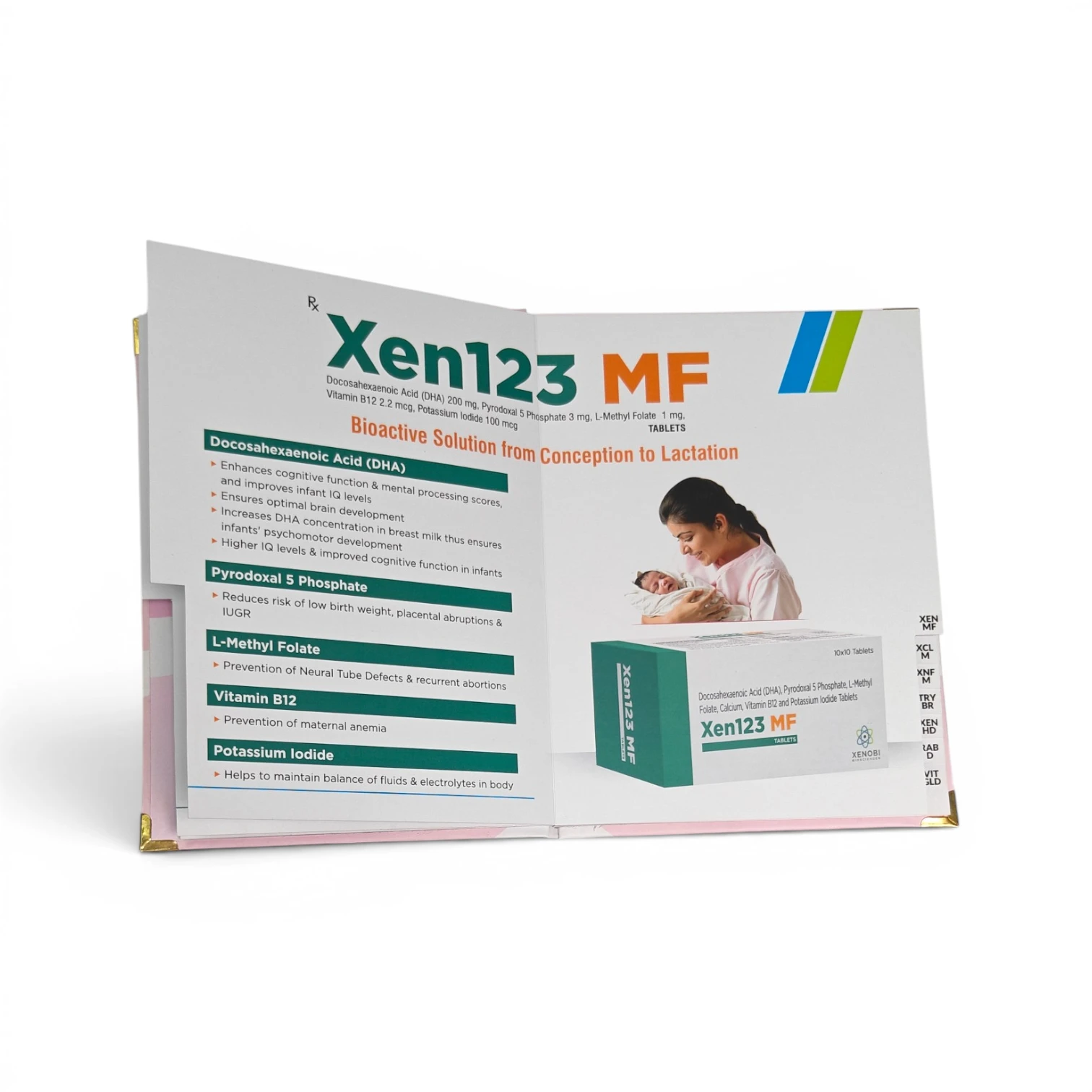
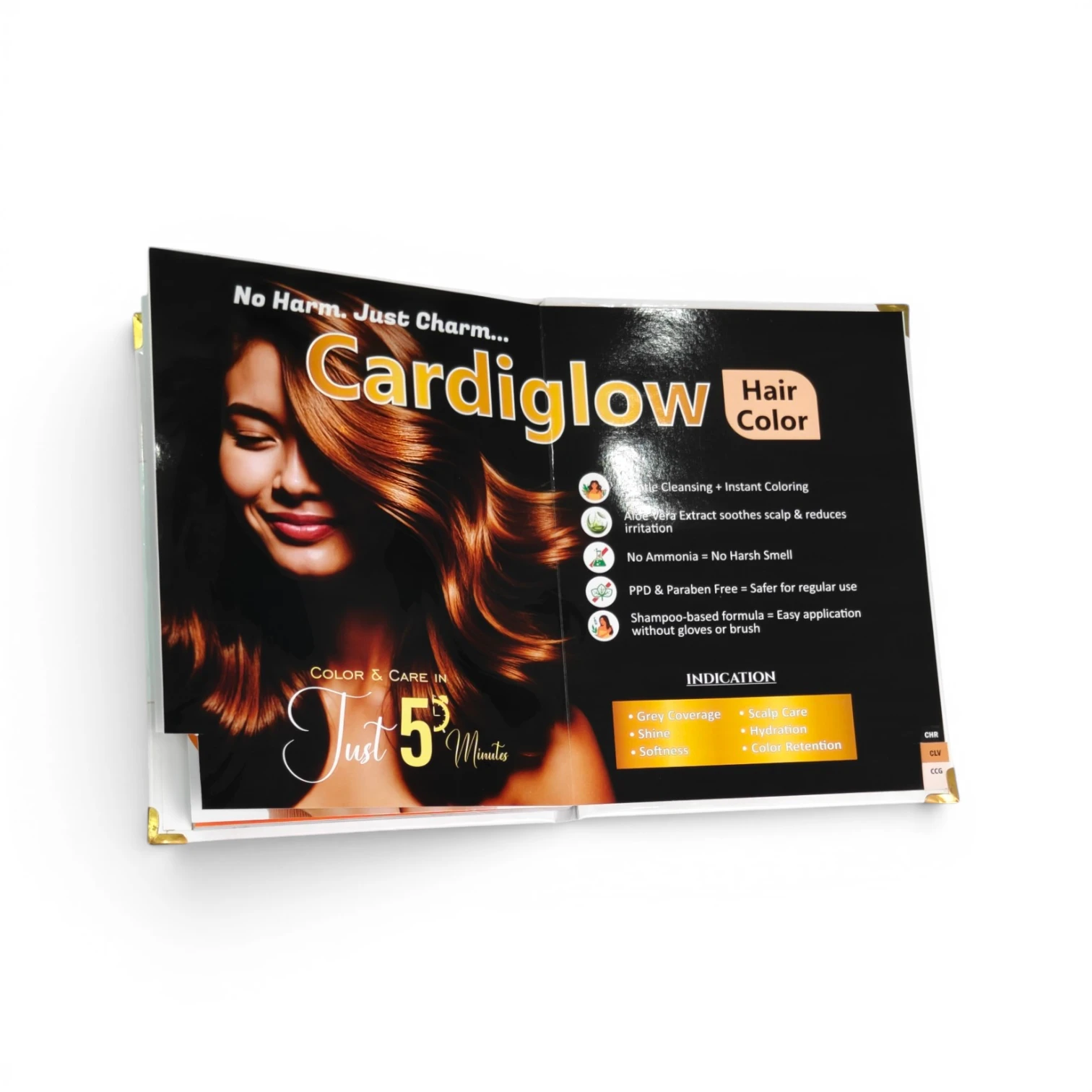
| Finish | Price level | Why the price differs | Best for |
|---|---|---|---|
| Matte + spot UV | Highest | Matte lamination plus a separate UV coating pass on chosen areas: two processes instead of one. | Flagship brand launches, top-doctor detailing |
| NTR (non-tearable) | Premium | Non-tearable synthetic stock that resists scuffs and moisture; the material itself costs more. | Large MR teams, books that must last a full cycle |
| Velvet | Soft premium | Soft-touch film costs more than matte or gloss film but needs no extra coating pass. | Derma, gynae and lifestyle brands needing a rich feel |
| Matte | Standard | Standard non-reflective lamination, single pass. Easy to read under clinic tube lights. | Everyday professional detailing books |
| Gloss | Standard | Bright, colour-rich lamination at the same rate as matte. | Colourful brands, high-quantity orders |
Spiral visual aids and catalogues
Almost every visual aid we make is back-to-back hardbound, which is why that is the only binding on the order page. Two other formats are quoted separately on WhatsApp:
- Spiral visual aids: made on request for teams that want pages to flip all the way round. Send the page count and quantity for a quote.
- Catalogues (softbound or staple-bound): the right format for launching 4–5 brands together or a full product list in one book. These are a separate product, priced by pages and quantity.
Does a bigger quantity reduce the price?
The printing & binding rate per book does not change with quantity, so there are no hidden “slab” surprises: 5 books and 500 books are printed at the same per-book rate. What changes is the design charge, which you pay only once. For a 12-page book, the all-in cost per book at 5 copies is roughly one and a half times the cost at 50 copies, purely because the design is shared across more books. Reprints of an approved design carry no design charge at all.
Design + printing together usually costs less
Most printers quote printing only and leave you to arrange design separately. Because RX Design Hub handles pharma visual aid designing and production under one accountable team in Lucknow, a combined design-plus-print order removes file-handover errors, reprint risk from wrong bleed or colour settings, and a second vendor's margin. You send the brand name and product details after ordering; we handle content layout, print-ready artwork and production. See our visual aid design samples for the finish quality to expect.
New to visual aids? Start with our guide on what a visual aid is in pharma marketing, see how MRs actually use them on the visual aid for MR page, or read the 2026 visual aid budget guide.
Visual aid printing price: FAQs
How is the visual aid printing price calculated?
Total = printing & binding rate per book (set by page count and finish) × quantity, plus a one-time design charge per page, plus 18% GST. Enter pages, finish and quantity on the order page to see the exact figure.
What is the minimum order quantity for visual aids?
5 books, for any page count and finish.
Does a higher quantity reduce the per-book printing rate?
No. The printing & binding rate per book is the same at any quantity. The all-in cost per book still falls as quantity rises, because the design charge is paid only once.
Which finish is costliest and which is cheapest?
Costliest to most economical: matte + spot UV, NTR (non-tearable), velvet, then matte and gloss at the same rate.
Which paper do you use?
It is set automatically by page count: 300 GSM art paper up to 24 pages, 250 GSM for 25–30 pages and 170 GSM for 31–40 pages, printed back-to-back and pasted into a hardbound book.
Which binding do you use? Do you make spiral or softbound books?
Visual aids are back-to-back hardbound. Spiral visual aids are made on request, and softbound or staple-bound books are catalogues, a separate product. Both are quoted on WhatsApp.
Is design charged separately?
Yes, per page and only once per design, with 3 correction rounds and a PDF proof on WhatsApp before printing. If you supply a print-ready file there is no design charge, and reprints of an approved design carry none either.
How long does a visual aid order take?
The design proof comes in 3–6 working days. Printing and binding take 8–12 working days after you approve the proof, then the books are couriered from Lucknow.
How do I pay?
Place the order online and pay a 50% advance by UPI to RX Design Hub's business account; the balance is due before dispatch. Paying the full amount upfront gets 1% off.
Do you deliver outside Lucknow?
Yes. We design, proof and bind in Lucknow, print through partner presses to our specification, and courier finished books across India. See our pan-India pharma printing page for coverage.
Get your exact visual aid price in minutes
See the full quotation with GST on screen, then place the order with your company name and WhatsApp number. Our design team collects brand details and shares the proof on WhatsApp after confirmation.
Planning repeat visual aids, reminder cards or pads across the year? See our pharma printing rate contract guide for volume-slab and release-order planning.