BLOG · PCD PHARMA FRANCHISE
Visual Aid for PCD Pharma Franchise: Requirements, Cost & Fast Turnaround
A PCD pharma franchise partner does not order like a big company. The quantity is smaller, the timeline is tighter, and very often the person placing the order is buying a visual aid for the first time. Get those three realities right and the print vendor becomes a partner. Ignore them and the PCD owner quietly moves to someone who understands the model.
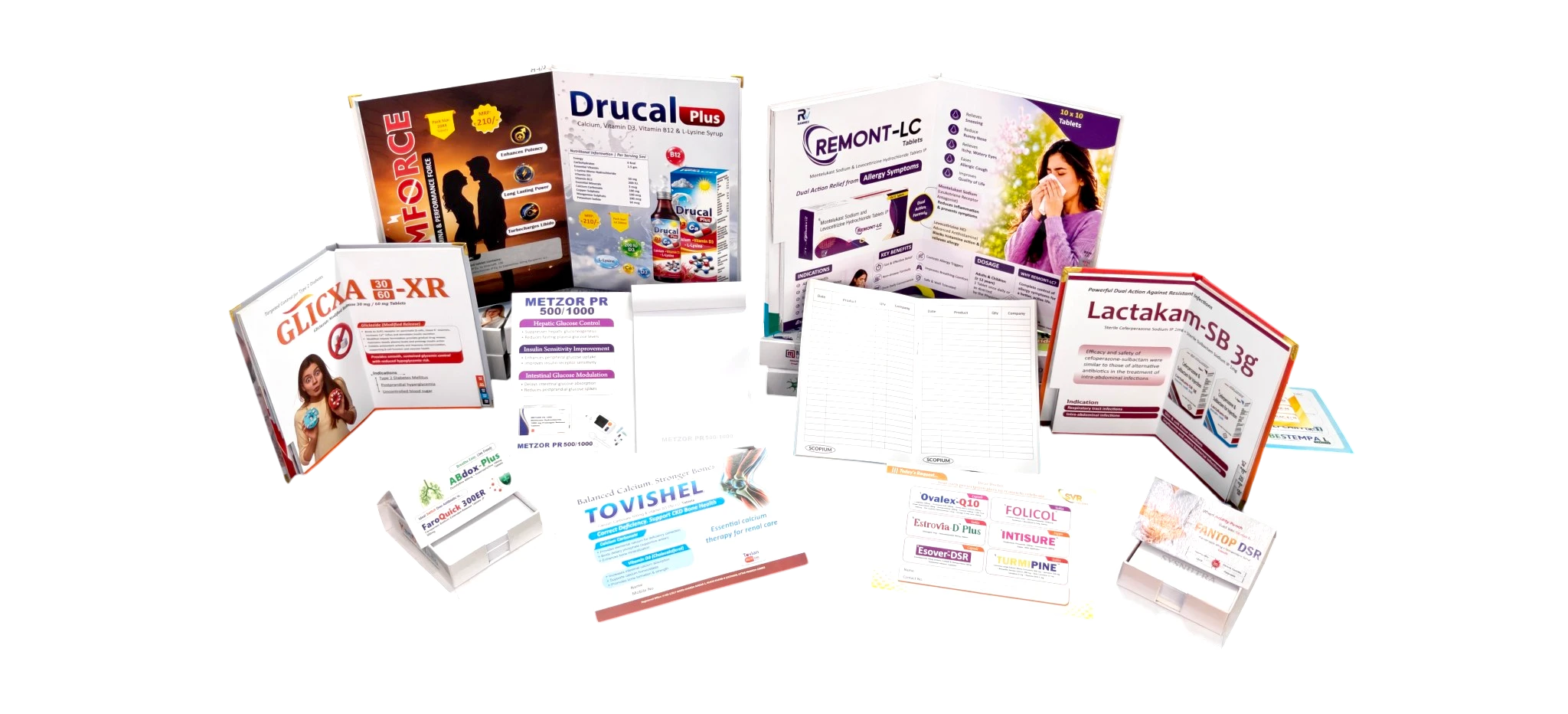
A PCD pharma franchise needs a visual aid that works at small scale, ships fast and can be reprinted at the same rate. Unlike a large company ordering thousands of books per division, a PCD partner usually wants a compact, professional detailing book in modest quantity, with specs guidance built in and a turnaround measured in days, not weeks.
At RX Design Hub we design and print for PCD pharma franchise partners almost every week, alongside larger pharma companies. The order pattern is genuinely different, and most generic printers never adjust for it. This guide walks through exactly what a PCD franchise should ask for in a visual aid, what it realistically costs, and why turnaround matters more here than anywhere else in pharma printing.
Why PCD franchise orders are different
PCD stands for Propaganda Cum Distribution. In practice, a PCD franchise owner takes distribution and promotion rights for a company's products in a territory, then builds their own doctor network. That business model shapes every printing decision:
- Quantities are small. A new PCD partner covering one or two districts may need 50 to 300 visual aids, not 5,000. A vendor with a high minimum order quantity simply cannot serve them.
- The buyer is often new to detailing tools. Many PCD owners come from a field or distribution background. They know doctors; they do not always know GSM, lamination or binding. They need guidance, not a spec form.
- Speed decides the deal. A PCD owner has usually already promised a doctor a product. The visual aid is holding up a live conversation, so a two-week turnaround can cost them the relationship.
- Branding sits between two names. The product belongs to the parent company; the relationship belongs to the franchise. A good PCD visual aid balances the parent brand with the franchise owner's own identity.
What a PCD franchise visual aid should actually contain
A PCD partner rarely needs a heavy 24-page book on day one. The goal is a tight, credible detailing tool that makes a small franchise look established. A workable structure looks like this:
- Cover: franchise or division name, clean logo, and a therapy-focused tagline. This is where a small company either looks professional or looks improvised.
- Company introduction page: a short, honest paragraph on the franchise, GMP/WHO certifications of the parent manufacturer, and the range covered.
- Product pages: one clear message per page — brand name, composition, a plain-language benefit, and dosage. Overloading is the single most common visual aid design mistake, and it hurts small franchises most because they have less brand equity to fall back on.
- Range or product-list page: a grouped table of the franchise's products so the doctor sees the depth of the basket.
- Back cover: franchise contact, territory, and a simple ordering line.
Pro tip: ask your designer to build the product pages on a repeatable template. As your PCD range grows, new molecules can be dropped into the same layout without a full redesign — and your reprints stay visually consistent.
What PCD clients demand that larger clients do not
This is the part most vendors miss. After printing for hundreds of PCD partners, a few requests come up again and again that you rarely hear from a large pharma marketing department:
1. Genuinely small quantities without a penalty
A big company spreads print setup cost across thousands of units, so the per-piece rate is low. A PCD partner ordering 100 books pays a higher per-unit rate because that same setup is shared across fewer pieces. That is normal — but the order should still be accepted gladly, not treated as a nuisance. A no-minimum-order policy is the single most important thing a PCD franchise should confirm before starting.
2. Help with specs, not a spec form
A first-time buyer should be able to say “I want a good detailing book for a cardiac range, budget-friendly” and get a recommendation — A5 vs A4, gloss vs matt, standard GSM, book-form vs spiral. Turning that into printable specs is the vendor's job, not the franchise owner's.
3. Same-day quote
Because a doctor conversation is usually already open, PCD partners value a quote turned around the same working day far more than a marginally cheaper rate delivered two days later.
4. Rate-locked, on-demand reprints
PCD ranges grow product by product. A partner needs to reprint the same book — or add two new pages — months later at a predictable rate, without re-negotiating from scratch each time.
Pro tip: keep your approved design files and page templates with a vendor who will reprint on demand. Chasing artwork across three freelancers every reprint is the hidden cost most PCD owners only discover on their second order.
What does a PCD franchise visual aid cost?
There is no honest single price, because cost depends on page count, finished size, paper GSM, lamination, binding style and quantity. What we can give you is the shape of the decision. For a compact PCD detailing book, the levers that move the price are, roughly in order of impact:
- Quantity — the biggest lever. Per-unit cost drops sharply as you move from tens to hundreds of copies.
- Page count — more spreads means more paper and more binding.
- Size and paper — A4 costs more than A5; heavier art paper costs more than standard.
- Finish — matt or gloss lamination, spot effects, and binding style each add a step.
Because every combination prices differently, the fastest route to a real number for your range is to share your product list and rough quantity for a same-day itemised quote. For a full breakdown of the factors, see our visual aid printing price guide, and for the bigger cost picture read pharma visual aid cost in India 2026.
Turnaround: the real PCD advantage
For a PCD franchise, speed is not a luxury feature; it protects a live doctor relationship. A realistic timeline for a compact franchise book, when design and printing sit under one accountable team, looks like this:
- Day 0: share franchise name, product list and compositions on WhatsApp; receive a same-day quote and route.
- Day 1–4: design proof shared on WhatsApp for review.
- Corrections: handled digitally, usually within a day.
- Print, bind, dispatch: approved files move straight to production and pan-India dispatch with tracking.
The reason this compresses is simple: when the same team designs, prints and binds, a franchise owner is not coordinating a designer, a press and a binder separately. That coordination is exactly what eats a week in the typical arrangement.
A short checklist before you order
- Confirm the minimum order is small (ours is 5 books).
- Ask whether the vendor will advise on specs if you are unsure.
- Confirm you get a same-day quote and a clear timeline.
- Ask whether reprints are rate-locked and files are retained.
- Check that design, printing and binding are under one accountable team so turnaround holds.
Get those five right and a small franchise can look and detail like an established company from its very first order.
What is the minimum order for a PCD pharma visual aid?
It should be small. A good vendor will accept modest PCD quantities such as 50 to 300 books without a penalty. RX Design Hub starts at just 5 books, so a new franchise can start with the quantity it actually needs. The per-book printing rate stays the same at any quantity; only the one-time design charge is spread over fewer books on a small run.
How is a PCD visual aid different from a big company's visual aid?
The content structure is similar, but the order pattern is different. PCD orders are smaller, faster, and often placed by a first-time buyer who needs help with specs. The design should also balance the parent company's product branding with the franchise owner's own identity.
How fast can a PCD franchise visual aid be printed?
When design, printing and binding sit under one accountable team, a compact franchise book can move from brief to dispatch in a few working days plus production time. The quote is usually same-day, the proof follows within a few days, and corrections are handled digitally on WhatsApp.
What should a PCD franchise visual aid include?
A clean cover with the franchise name and logo, a short company introduction, one-message-per-page product spreads, a grouped range or product-list page, and a back cover with contact and ordering details. Keeping it tight makes a small franchise look established.
Can I reprint or add products to my PCD visual aid later?
Yes, and you should confirm this before ordering. Ask the vendor to retain your approved files and page templates so new molecules can be added to the same layout and the book can be reprinted at a predictable rate as your range grows.
What decides the cost of a PCD franchise visual aid?
Quantity has the biggest impact, followed by page count, finished size, paper GSM, lamination and binding style. Because every combination prices differently, sharing your product list and rough quantity is the fastest way to get a real, itemised number.
Does RX Design Hub work with PCD franchises outside Lucknow?
Yes. Around 70% of orders ship outside Lucknow. Design and proofing happen over WhatsApp and email, and finished stock is dispatched pan-India with tracking, so a PCD partner in any state gets the same process.
Get a same-day quote for your PCD franchise visual aid
Share your franchise name, product list and rough quantity on WhatsApp. You will get a same-day quote, a clear timeline and a design route sized to a PCD budget.